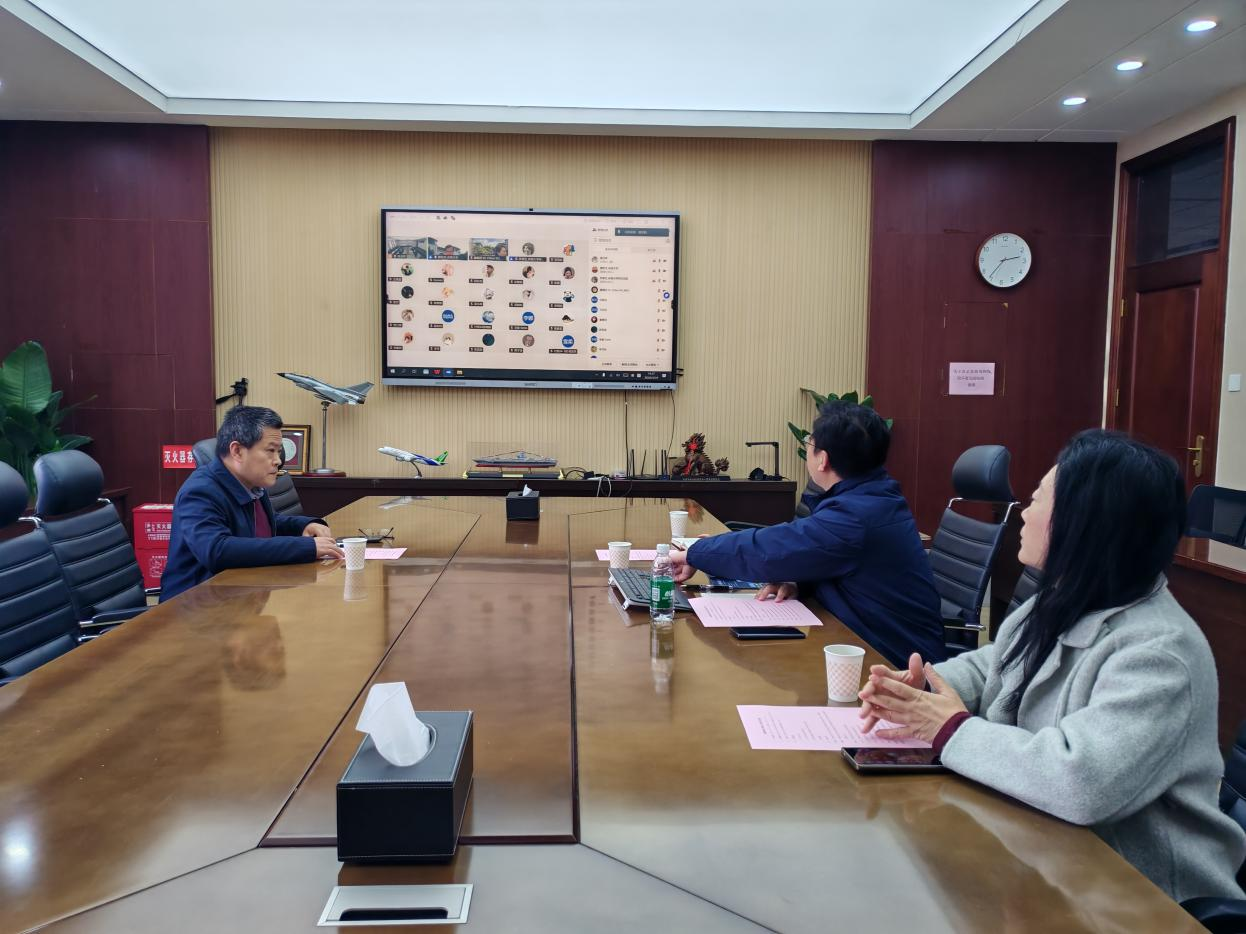
On March 19, our school held an online postgraduate program recruitment and exchange seminar with Lingnan University (Hong Kong). Attending the meeting from Lingnan University (Hong Kong) were Associate Professor Huang Genghua, Program Director of Master of Social Sciences in Comparative Public Policy at the Graduate School; Dr. Xiao Bei'er, Deputy Program Director of MSc in Health Analytics and Management and MSc in Smart Ageing and Gerontology; Ms. Li Ziyi, Level II Assistant Manager of the Graduate School; Li Na, Administrative Officer of the Graduate School; and Peng Chen, Assistant Administrative Officer of the Graduate School.
Representing the School of Public Policy and Administration at China University of Mining and Technology (CUMT) were Yan Qingwu, Vice Dean of the school; Gong Yunlong, Director of the Office of International Cooperation and External Exchanges; Ma Yajing, Deputy Director of the same office; Li Yue, Director of the Student Affairs Office; teachers from relevant departments and research institutes; and nearly 100 students majoring in administrative management and other related majors on campus. The online event was chaired by Vice Dean Yan Qingwu.
At the seminar, Gong Yunlong introduced the long-standing educational heritage, strong disciplinary strength of CUMT, as well as the interdisciplinary professional features of management and engineering and the achievements in disciplinary construction of our school, demonstrating the school’s proactive attitude in expanding international exchanges and cooperation.
The delegation from Lingnan University (Hong Kong) presented the university’s educational advantages and focused on promoting three postgraduate programs that are highly compatible with the public administration majors of CUMT: Master of Science in Health Analytics and Management, Master of Science in Health and Social Service Management, and Master of Social Sciences in Comparative Public Policy. Notably, the Comparative Public Policy major has added a new concentration in Digital and Smart Governance, which integrates artificial intelligence (AI) technology, emphasizes an international vision, and incorporates experiential learning activities such as visits to the Legislative Council and policy simulation exercises.
The teachers from Lingnan University answered questions raised by CUMT teachers and students one by one. They noted that graduates of the relevant postgraduate majors enjoy a high employment rate in Hong Kong and the Guangdong-Hong Kong-Macao Greater Bay Area, and the academic degrees are recognized by the Service Center for Chinese Study Abroad, Ministry of Education of China. In addition, they introduced the tuition fees and living options for students in Hong Kong, and mentioned that the university offers entrance scholarships and academic scholarships, which are awarded based on applicants’ undergraduate institution background, academic performance and interview performance.
It was also clarified that the admission adopts an application-based system, with the application period starting every October and closing at the end of June. A minimum score of 450 in the College English Test Band 6 (CET-6) is accepted as a substitute for IELTS or TOEFL scores, and rolling online interviews are held throughout the year.
The two sides also held in-depth discussions on inter-university cooperation. The School of Public Policy and Administration of CUMT put forward proposals for exploring "3+1/3+2" joint education programs, as well as carrying out joint research projects and co-construction of courses. Lingnan University responded positively to these proposals and looked forward to building a multi-dimensional cooperation bridge between the two institutions.
A recruitment and exchange WeChat group was established for students to facilitate follow-up Q&A, and junior students were advised to prepare for the CET-6 in advance and make sound plans for further study.
This exchange has not only broadened the channels for further study for CUMT students, but also built an inter-university communication platform for the two schools, laying a solid foundation for in-depth cooperation in talent cultivation, academic research, internship and practice in the future. It will help both sides achieve resource sharing and complementary advantages, and boost the high-quality development of international talent training and disciplinary cooperation.
Brief Introduction to Lingnan University (Hong Kong)
Lingnan University (LU), abbreviated as Lingnan, has a long-standing history that can be traced back to Canton Christian College, founded in Guangzhou in 1888. It was re-established in Hong Kong in 1967, positioning itself as a public liberal arts university in Hong Kong, China. As a founding member of the Asian Liberal Arts Universities Alliance and a member of the World Liberal Arts Colleges Alliance, it is one of the eight key public universities in Hong Kong, under the jurisdiction of the Education Bureau of the Hong Kong Special Administrative Region of the People’s Republic of China, and also a member of the Guangdong-Hong Kong-Macao University Smart Campus Alliance.
For consecutive years, Lingnan University has earned the highest score in the “Satisfaction with the Quality and Value of Undergraduate Teaching Experience” survey among the eight publicly funded universities in Hong Kong. In the 2023 QS World University Rankings by Subject, its Social Policy and Administration ranked 51st-100th globally. The university takes the leading position in Hong Kong in Accounting, Sociology and Anthropology, Social Work, and Social Policy Studies, and ranks second in Hong Kong in Philosophy research.
More than 80% of Lingnan University’s undergraduate students have the opportunity to study as exchange students at over 270 partner institutions across approximately 50 countries and regions worldwide. In terms of joint academic programs, the university has launched dual-degree programs at the master’s and doctoral levels in selected research fields with renowned universities including Renmin University of China, Wuhan University, National Chengchi University (Taiwan, China), and Shenzhen University.